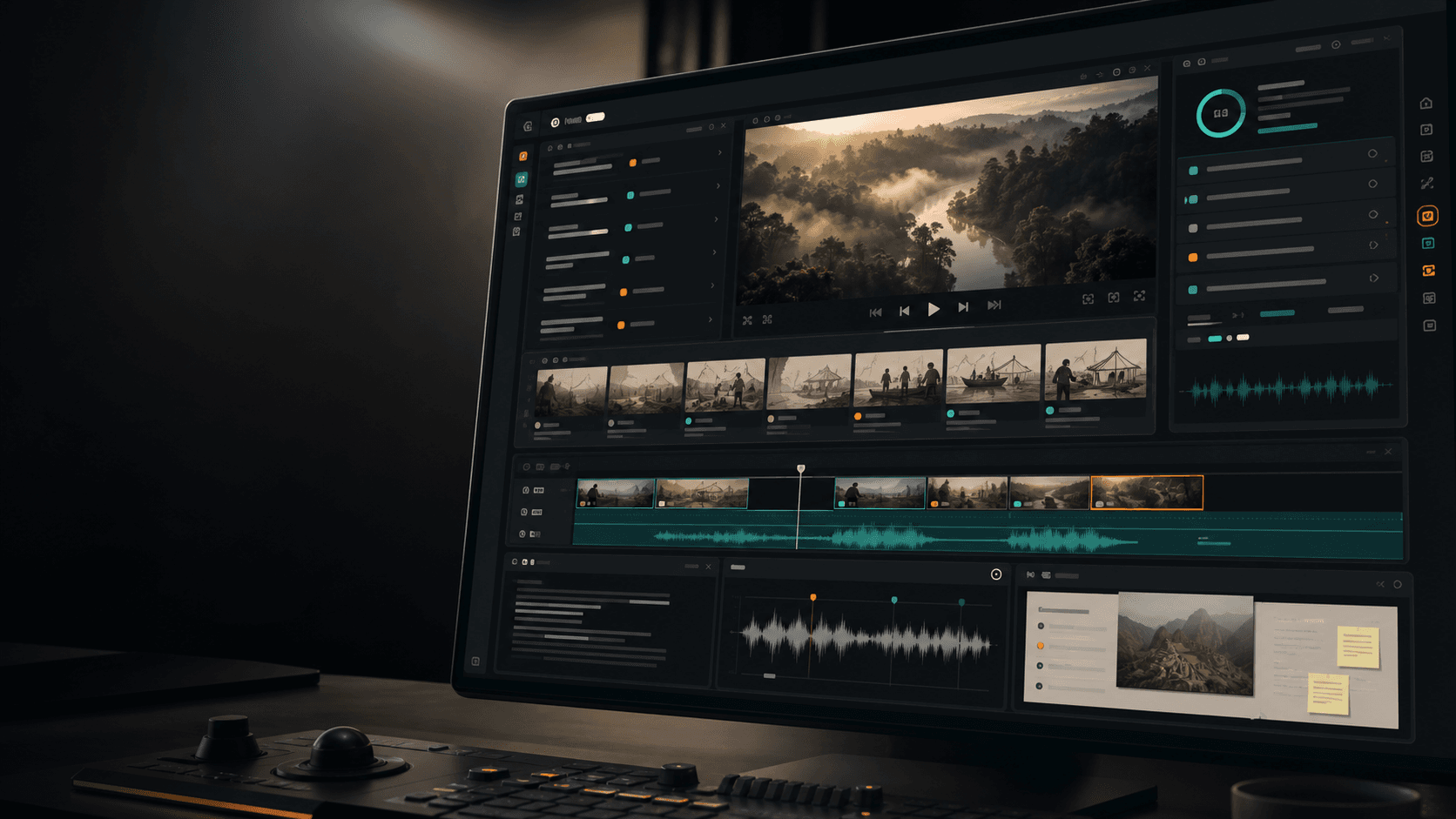
Autonomous YouTube video creator
Narra
A cloud production cockpit that turns a channel-aware idea and human voiceover into a researched script, timed storyboard, consistent generated visuals, captions, and an export-ready MP4.
64 images and 6.2 render minutes are paused until the operator confirms estimated provider spend.
Cold open: monitor glow, quiet editing room, one waveform as the timeline spine.
Macro stills of research sources becoming pinned story beats.
Wide cinematic shot of generated visuals locked to narration timing.
Production OS
One saved project. Six rerunnable stages.
Narra is built around explicit production objects: channel memory, ideas, scripts, voiceover assets, transcripts, storyboard shots, generated visuals, jobs, and final exports. That is what makes the system controllable instead of a one-shot prompt box.
Research intelligence
Daily jobs turn your niche, channel history, and fresh sources into a ranked backlog with hook, angle, why-now, fit, novelty, and citations.
Agentic script desk
Narra researches, outlines, drafts, critiques, revises, fact-checks, and returns a scorecard before the script becomes production material.
Human voiceover ingest
The creator records the read. Narra treats that human voice as the master timeline and aligns transcription back to the approved script.
Shot planning
Sentences and clauses become natural shot boundaries, each with a visual brief, seed, timing window, and reviewable storyboard row.
Consistent visuals
A locked channel identity, reference notes, palette, and composition rules constrain every generated still so the channel keeps a coherent look.
Cloud render
Timed visuals, captions, motion, audio, and optional music are handed to a cloud renderer for a YouTube-ready MP4 export.
Why it is worth paying for
A serious creator needs control, not novelty.
The product promise is not that AI makes a video by magic. It is that Narra makes the hard repetitive parts durable, observable, and cheap to rerun while preserving the human editorial core.
Anti-slop pipeline
Research dossiers, critique loops, fact checks, originality checks, and human voice keep the work away from generic AI filler.
Cost control
Narra estimates image and render spend before expensive batches and pauses above the configured threshold until the operator confirms.
Stage reruns
Research, script, storyboard, visuals, render, and export are saved independently so you can rerun the weak stage without restarting.
Creator control
No auto-publish, no synthetic voice requirement, no forced approvals. The creator makes editorial calls; Narra removes production drag.
Pricing
A real production system, priced like one.
Narra is not a caption toy. The subscription buys the operating system for a channel; provider spend is estimated before expensive media batches so you stay in control.
Production
The full autonomous production cockpit for one serious channel.
- One persistent channel memory: voice, topic map, visual identity
- Daily research backlog with fit, novelty, angle, and sources
- Agentic script desk: dossier, outline, draft, critique, fact-check
- Human VO ingest, word timing, storyboard, image generation, render handoff
- Provider cost estimate and confirmation before expensive batches
- 1 active channel workspace
- Unlimited idea and script drafts within fair use
- 1080p MP4 exports through the cloud render pipeline
- Media provider spend is estimated before generation and is separate from the subscription.
- Generated images are cached by prompt, seed, model, and visual identity so reruns do not rebuy the same shots.
Studio
For operators running several channels or a managed content room.
- Multiple channel workspaces and identity systems
- Higher render throughput and batch production planning
- Operator handoff for script review, shot review, and exports
- Provider setup review across OpenAI, Deepgram, R2, Trigger, and Modal
- Roadmap input for studio-grade controls before self-serve rollout
- Multi-channel workspace architecture
- Volume render planning and provider capacity review
- Priority support for launch-critical production runs
- Commercial terms are scoped around channel count, provider volume, and workflow support.
- Studio is sales-led until hard team limits and pooled media credits are enforced in-product.
Production is the self-serve cockpit for one active channel. It unlocks channel memory, research, scripting, VO timing, storyboard, visuals, render, and export workflows.
OpenAI image batches, ASR, storage, and render work are estimated before expensive runs. Cost gates and image caching prevent surprise reruns.
Multi-channel work stays sales-led until usage pools, team seats, and throughput limits are enforced directly inside Narra.
Launch Concierge
A guided setup sprint for the first channel and first finished video.
- Channel memory import from existing scripts and positioning
- Visual identity calibration for consistent generated stills
- Provider configuration and cost-control review
- First video workflow validation from idea to export
- One launch sprint
- One primary channel
- First finished workflow validated end to end
- Concierge setup does not replace the Production subscription for ongoing self-serve use.
- Provider accounts, paid API usage, and any third-party media costs remain separate.
Polar handles the subscription. OpenAI image batches, ASR, storage, and render work are estimated inside the project before costly runs.
That keeps the public promise honest while still giving serious teams a path to higher throughput and implementation support.
Built with sharp V1 boundaries.
Is Narra an AI voice tool?
No. V1 is deliberately built around human voiceover because the voice is the clearest quality signal. Narra handles the research, timing, storyboard, visuals, and render around that read.
Does Narra upload to YouTube?
Not in V1. Narra exports the MP4, assets, transcript, storyboard, and research material. The creator handles upload and final channel decisions.
Why not charge per finished video?
Provider costs vary by duration, image count, render time, and retries. The subscription covers the production operating system; costly media runs are estimated before execution.